
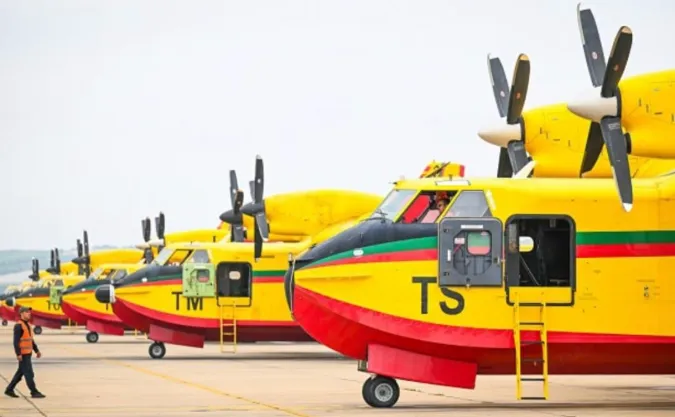
Morocco's Royal Armed Forces (FAR) lead the aerial forest fire response by deploying their full range of firefighting assets. The force deploys a fleet of eight Canadair CL-415 aircraft operated by the FAR, as well as 15 Turbo Thrush aircraft and two EC225 Super Puma firefighting helicopters operated by the Royal Gendarmerie.
These efforts are part of a proactive national forest fire strategy implemented through close coordination among the Royal Armed Forces' specialized units, the Royal Gendarmerie, the Auxiliary Forces, Civil Protection, local authorities, the National Center for Forest Climate Risk Management, the National Agency for Water and Forests (ANEF), and the General Directorate of Meteorology.
Operating from the Royal Air Force's 3rd Air Base in Kenitra, the Canadair fleet carries out a significant share of aerial firefighting operations under a national four-tier response system.
Under the first response level, ground crews handle fire suppression. Canadair aircraft are deployed when fires reach the second level, while third-level incidents require the mobilization of the Royal Gendarmerie's aerial units. The fourth level requires international assistance to help protect lives, property and forest resources.
Speaking to the press, Lieutenant Colonel Badr Bourassi, commander of the forest firefighting squadron at the 3rd Air Base in Kenitra, said the unit's primary mission is to protect forests, people and property by ensuring rapid and effective intervention as soon as a fire breaks out, in constant coordination with all stakeholders at both the central and field levels.
He said the effectiveness of these operations depends on the constant readiness of flight and technical crews, as well as seamless coordination among pilots, technicians and all responders, stressing that rapid intervention is essential to containing fires and minimizing their impact.
Bourassi added that the squadron takes part each year in Morocco's national forest fire campaign and has also participated in overseas missions within the framework of cooperation with friendly countries. He said the squadron's guiding principles are readiness, professionalism and service to the nation.
For his part, Captain Anas Bel-haj, a Canadair pilot, said the amphibious aircraft is specifically designed for forest firefighting and can refill directly from the sea, dams or lakes without returning to an airport.
The scooping operation takes about 12 seconds, allowing the aircraft to load more than 6,000 liters of water before flying directly to the fire to release its payload and help contain the flames, he explained.
He noted that the aircraft was designed to operate under demanding conditions and that its technical capabilities allow it to access mountainous terrain and dense forests that are difficult to reach by other means.
Bel-haj added that each aircraft is operated by a two-pilot crew working in close coordination to ensure every phase of the mission is conducted safely and efficiently, noting that Canadair aircraft are among Morocco's principal aerial firefighting assets during the summer season.
Regarding the Royal Gendarmerie's Super Puma helicopters, Warrant Officer Fatima Zahra Afechkou said the aircraft have been equipped with a modern firefighting system featuring an underslung tank capable of carrying around 2,500 liters of water or fire retardant, which can be refilled in just 20 seconds from a nearby lake, dam or other water source.
She said the new system, combined with the expertise of Royal Gendarmerie pilots and close coordination with ground teams and local authorities, enables every mission to be carried out with the highest levels of precision and professionalism.
Meanwhile, Warrant Officer Mohamed Diba, a Turbo Thrush pilot, said the aircraft is among those specialized in forest firefighting, with a payload capacity ranging from 2,000 to 2,500 liters and an endurance of approximately four and a half hours. He noted that firefighting drops are conducted under conditions that combine rapid response with strict safety requirements.
Diba added that all operations rely on close coordination with the command center, local authorities and ground teams, helping improve operational efficiency, contain the spread of flames and ultimately bring fires under full control.
This operational readiness is supported by a preventive and periodic maintenance program carried out outside the forest fire season. Aircraft undergo major overhauls lasting several months, including inspections and refurbishment of key systems such as landing gear, water tanks and engines, in addition to daily and scheduled maintenance to address the effects of seawater salinity and smoke exposure, ensuring the fleet remains fully operational throughout the firefighting season.
Addressing the fleet's readiness, Colonel Major Rachid Akkaoui, commander of the Royal Air Force's General Support Air Base, said that "the Royal Air Force's General Support Air Base is now capable of returning the aircraft to service in fully operational condition while strictly complying with the highest airworthiness and flight safety standards, thanks to the expertise acquired in carrying out major overhauls of Canadair aircraft."
In his words, "this capability, built entirely on local expertise, reduces aircraft downtime, ensures greater fleet availability and strengthens national sovereignty in the field of heavy aircraft maintenance."
For her part, Chief Warrant Officer Rahma Jomoua, an avionics systems technician specializing in Canadair aircraft, explained that major overhauls include the refurbishment of avionics equipment and electrical wiring networks, which are among the aircraft's key navigation, communication and control systems.
She said the process includes inspecting electronic equipment, repairing or replacing defective components, and verifying the integrity of electrical connections in accordance with applicable standards. These operations help ensure the reliability of electronic systems, improve aircraft performance and enhance safety during aerial missions.
The integrated system, built on institutional coordination, operational readiness, continuous training and specialized maintenance, reflects the Royal Armed Forces' commitment to contributing effectively to the protection of Morocco's forest heritage and environment, strengthening the Kingdom's capacity to respond rapidly and efficiently to forest fires while minimizing their impact on people and property.
In this context, Abderrahim Houmy, Director General of the National Agency for Water and Forests (ANEF), highlighted Morocco's deployment of significant human and technical resources, including more than 2,800 forest lookouts and rangers stationed across the Kingdom to carry out surveillance and early warning missions.
Houmy said the system is supported by an aerial fleet comprising Canadair aircraft, each capable of carrying six tonnes of water, dedicated to extinguishing fires and preventing their spread, in addition to helicopters with a two-tonne capacity and Turbo Thrush aircraft capable of carrying between 1.5 and 3 tonnes.
He also noted that the ground response system includes a large number of rapid-response vehicles operated by ANEF alongside Civil Protection trucks and equipment, specialized Royal Armed Forces units, the Royal Gendarmerie, the Auxiliary Forces and local authorities, all operating under a unified command structure and permanent coordination.
(MAP: 03 August 2026)