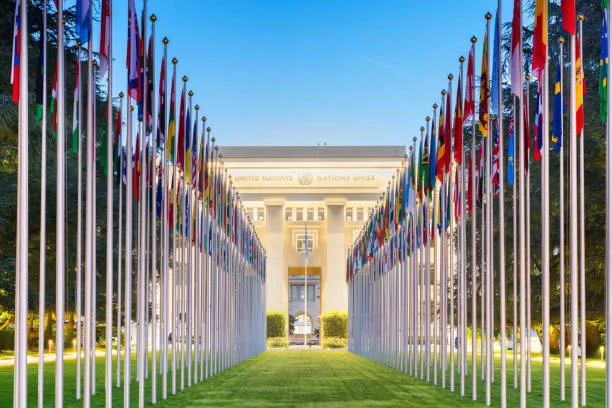
The need to reconcile digital sovereignty, technological innovation, and the protection of human rights through better coordination between national and international regulatory frameworks was highlighted at a meeting held Monday in Geneva, on the sidelines of the 15th United Nations Forum on Business and Human Rights.
Organized by the International Observatory for Peace, Democracy and Human Rights (IOPDHR-GENEVA-NGO), in partnership with the Geneva AI Governance Institute (GAIGI), the meeting examined the challenges and prospects of artificial intelligence (AI) development in Morocco, North Africa and across the African continent, in light of the 2011 United Nations Guiding Principles on Business and Human Rights.
Axel Mazolo, founder and Executive Director of GAIGI, cited Morocco as an example of the challenges involved in ensuring interoperability between AI regulatory frameworks, stressing that national and regional regulations should recognize one another without requiring a uniform global framework.
Referring to the "Morocco AI 2030" roadmap and the draft "Digital X.0" framework law, he underscored the need to align requirements on transparency, algorithmic explainability and respect for fundamental rights.
Such mutual recognition would facilitate the activities of African companies operating across multiple markets and help prevent regulatory fragmentation from disproportionately affecting smaller businesses and individuals subject to automated decisions.
Karima Rhanem, an AI and communications expert and strategist, outlined the three pillars of the "Morocco AI 2030" roadmap: sovereignty and trust, innovation and competitiveness, and impact and international outreach. The strategy aims by 2030 to generate 100 billion dirhams in added value, create 50,000 direct and indirect jobs, and train and certify 200,000 professionals.
Rhanem also highlighted the role of the JAZARI Institutes in developing Morocco's innovation ecosystem and initiatives to adapt AI solutions to the country's linguistic specificities, particularly Moroccan Darija. She also stressed the importance of cybersecurity, personal data protection and skills development.
Opening the meeting, Aicha Duihi, President of IOPDHR-GENEVA-NGO, warned that automated systems increasingly influence access to employment, justice, social benefits and migration procedures.
She called for fundamental rights to be placed at the center of national AI strategies, citing risks of algorithmic discrimination, lack of transparency and privacy violations.
Sanjeewa Liyanage, Director of International Programs at Switzerland-based International Bridges to Justice (IBJ), said AI could improve access to legal information and help connect detainees, particularly those from disadvantaged backgrounds, with lawyers.
However, he stressed that technology should not replace human legal assistance or safeguards for fair trials, calling for independent human oversight, confidential lawyer-client communications and accessible, swift and free avenues for redress.
Biro Diawara, United Nations Affairs Program Officer at the African Meeting for the Defense of Human Rights (RADDHO), warned of the risks of disinformation, hate speech and public opinion manipulation linked to AI.
He called for a multi-stakeholder approach involving governments, businesses and civil society, as well as stronger international cooperation to develop standards that place human dignity at the center of technological development.
The speakers stressed that AI governance should be guided by the three pillars of the UN Guiding Principles on Business and Human Rights: the state's duty to protect human rights, the corporate responsibility to respect them, and access to effective remedies and reparation for those affected.
MAP: 24 November 2026